LA Referencia
Red de Repositorios de Acceso Abierto a la Ciencia
LA Referencia
Red de Repositorios de Acceso Abierto a la Ciencia

Noticias (159)
LA Referencia es uno de los ganadores del fondo JROST para el desarrollo de proyectos y tecnologías abiertas
Written by Comunicaciones
Invest in Open Infrastructure (IOI), iniciativa dedicada a mejorar la financiación y los recursos para tecnologías y sistemas abiertos que apoyan la investigación, anunció los ganadores del Fondo de Respuesta Rápida JROST 2020. LA Referencia fue uno de ellos.
Este fondo fue otorgado a LA Referencia para consolidar el desarrollo de un servicio de “estadísticas de uso”, iniciado como piloto en 2020 en el contexto del proyecto OpenAIRE que esta llegando a su fin. Gracias a este premio, será posible continuar el trabajo técnico que se ha venido realizando, esto “permitirá a la comunidad de investigación comprender mejor el impacto de la Ciencia Abierta”.
El fondo es parte de los esfuerzos de IOI, organización que surgió como un concepto y una coalición de la conferencia de 2018 Joint Roadmap for Open Science Tools (JROST), celebrada en Berkeley, CA. El premio fue creado como un medio para retribuir a la comunidad de infraestructuras y tecnologías abiertas. Este año la ayuda osciló entre los USD 5.000 y USD 10.000 y se buscaba que fueran destinados a actividades que son necesarias y que no serían posibles, o estarían en peligro, sin este financiamiento.
De acuerdo a IOI este año el fondo fue posible gracias a la generosidad de la Iniciativa Chan Zuckerberg , Crossref , ITHAKA , Hypothesis e Invest in Open Infrastructure.
LA Referencia: Bianca Amaro es reelegida como presidenta y Lautaro Matas es el nuevo secretario ejecutivo y técnico
Written by Comunicaciones
El Consejo Directivo de LA Referencia, constituido por los países miembro, por unanimidad ha reelegido a Bianca Amaro como presidenta por dos años más. Asimismo, ha designado a Lautaro Matas como el nuevo Secretario Ejecutivo y Técnico de la Red.
Bianca Amaro se desempeñó como presidenta de LA Referencia en el periodo de 2018-2020. Amaro recalcó que “es una emoción tener esta responsabilidad. Mi trabajo estará centrado en la inclusión: ¡qué vengan todos los países, porque juntos somos más fuertes!”.
Por su parte, Matas ha trabajado desde el comienzo de LA Referencia como el gerente Técnico. Su nuevo rol sumará a la secretaría ejecutiva sus perspectivas en materia de desarrollo tecnológico, y será complementado con la suma de un nuevo miembro al equipo de gestión.
Matas agradeció al Consejo Directivo esta designación, recalcando que su compromiso es por una red de repositorios que incluya aún más países, así como el avance tecnológico en materia de servicios basados en el acceso abierto a la ciencia.
Finalmente, la presidenta y el nuevo secretario, destacaron y agradecieron la colaboración activa de Andrea Mora Campos, representante de Costa Rica, en el proceso de transición de este año derivado de la triste pérdida de Alberto Cabezas.

-
El convenio fue firmado por la Fundación Española para la Ciencia y la Tecnología (FECYT), fundación pública dependiente del Ministerio de Ciencia e Innovación del país europeo.
-
Desde 2007 FECYT, junto a la Red de Bibliotecas Universitarias (REBIUN) de la Conferencia de Rectores de las Universidades Españolas (CRUE), gestiona RECOLECTA, el agregador nacional de repositorios de acceso abierto de España.
Este miércoles 21 de octubre, España ingresó como nuevo miembro de LA Referencia, la red latinoamericana que cuenta con países asociados trabajando por la Ciencia Abierta. El convenio de adhesión fue firmado a través de una conferencia virtual por Cecilia Cabello, directora de la Fundación Española para la Ciencia y la Tecnología (FECYT), Bianca Amaro, presidenta de LA Referencia y Luis Eliécer Cadenas, director ejecutivo de la RedCLARA.
De esta manera América Latina y España consolidan, ahora en el campo de la Ciencia Abierta, su histórica tradición en colaboración científica y tecnológica, aspecto que fomenta la accesibilidad y generación de ideas encaminadas a unir las distintas visiones en un frente común por la Ciencia Abierta.
Bianca Amaro, presidenta de LA Referencia, explicó la importancia de este acuerdo para la red. “La unión de un país como España es un avance muy grande, tanto para LA Referencia, como para sí mismo. La incorporación de un nuevo país es muy importante porque, debido a que fortalecemos aquello que hacemos dentro de la red, es la fuerza de la ciencia hispanohablante”, puntualizó Amaro.
Por su lado, Luis Eliécer Cadenas, director ejecutivo de la RedCLARA, señaló los procesos de colaboración que han unido a América Latina con España, así como la necesidad de continuar abriendo camino en estos ámbitos. “Esta alianza es muy significativa porque RedCLARA y las redes nacionales de educación tienen una historia de cooperación con España y con Europa muy importante. Estamos estructurando una red de apoyo y colaboraciones que, eventualmente, pueden poner cada vez más la ciencia y las inversiones en educación y el avance científico al servicio y soporte del desarrollo económico de Latinoamérica y a nivel global”, subrayó Cadenas.
La directora de la FECYT, Cecilia Cabello, mostró su entusiasmo ante la incorporación de España a los esfuerzos que realiza LA Referencia en materia de ciencia y acceso abierto. “Hoy es un gran día para la FECYT, pero sobre todo para el sistema español de ciencia y tecnología. RECOLECTA se ha convertido en una herramienta clave para el cumplimiento del mandato nacional del acceso abierto, así como una parte clave de las iniciativas que tenemos sobre el tema de la ciencia abierta. La firma de este convenio nos coloca internacionalmente en una posición estratégica que aportará enormes beneficios. Esta alianza afianzará la relación entre España y América Latina y fortalecerá las visiones de acceso abierto y ciencia abierta en un espacio geográfico mucho más amplio”, comentó Cabello.
Cecilia Cabello aprovechó el espacio para mencionar las posibilidades que abre esta incorporación para los países hispanohablantes: “esta unión con los países Iberoamericanos contribuye a la apuesta institucional de FECYT a favor del fortalecimiento de la ciencia en español, ya que aumentará exponencialmente la visibilidad de la ciencia de España recogida en RECOLECTA”.
Bianca Amaro, por su parte, finalizó el evento de la firma del convenio recordando la importancia de esta incorporación: “ahora somos uno solo trabajando en pro del desarrollo científico de nuestros países, juntos somos más fuertes. Creo que el progreso, el desarrollo y los grandes logros que podemos alcanzar juntos, están ahora a nuestra disposición”.
España suma a LA Referencia su agregador nacional, RECOLECTA, que tiene como objetivos impulsar y coordinar la infraestructura nacional de España de los repositorios científicos digitales de acceso abierto y garantizar que sean interoperables según los estándares de la comunidad mundial; promover, apoyar y facilitar la adopción del acceso abierto por todos los investigadores de las universidades y centros de I+D españoles y dar mayor visibilidad nacional e internacional a los resultados de la investigación que se realizan en el país europeo.

Public version 1 – October 8, 2020
The community framework will be reviewed annually. Please send feedback to This email address is being protected from spambots. You need JavaScript enabled to view it.
Purpose
The purpose of the framework is to assist repositories to evaluate and improve their current operations based on a set of applicable and achievable good practices.
Currently, there are a number of existing frameworks and evaluation criteria that were developed to assist repositories in assessing certain facets of their operations (such as discovery, access, reuse, integrity, quality assurance, preservation, privacy, and sustainability), but these criteria are spread across different organizations and are often relevant for only one region or one type of repository.
The aim of this work was to bring together relevant criteria into a global, multidimensional framework for assessing best practices that can be adopted and used by different types of repositories (publication, institutional, data, etc.) and in different geographical and thematic contexts.
Process
The COAR Working Group reviewed existing frameworks, identified gaps, and assessed their level of importance, relevance and feasibility of implementation, and categorized each characteristic as either essential or desired. The framework was disseminated to COAR members in June 2020 for feedback and comments. This version is being disseminated more widely to other stakeholder communities (RDA, national repository networks, etc.) during September 2020 with the aim of having a version to publish on the COAR website in October 2020.
COAR is seeking community input about the essential and desired characteristics for repositories. In particular, we are interest in your comments related to:
- Ease of Adoption – Are any of the essential characteristics too difficult to implement?
- Gaps – Are there any important criteria missing?
- Clarity – Are any of these criteria difficult to interpret?
- Relevance – Are any of these criteria not appropriate?
In the coming months, COAR will be working to provide links and citations to examples, guides and instructions that will assist the community in adopting these best practices.
The COAR Repository Assessment Working Group will review the framework on an annual basis (in July/Aug each year) to ensure it reflects current best practices and is relevant for the diverse, international repository community.
Relationship with other assessment tools and frameworks
The following frameworks were taken into consideration for this work: Data Citation Roadmap for scholarly data repositories, Core Trust Seal, FAIR data principles, PLOS “Criteria that Matter”, TRUST Principles for Digital Repositories, COAR Next Generation Repositories Technologies, Plan S
Definitions
Content resource: This refers to the object or item that has been deposited / uploaded into the repository (e.g. manuscript, dataset, video)
Metadata record: This refers to the collection of metadata elements for a given resource
Landing page: This describes the repository page which represents a particular content resource in the repository
Objective |
Essential Characteristic |
Desired Characteristic |
|---|---|---|
1. Discovery |
1.1 The repository supports quality metadata and controlled vocabularies (discipline-based, regional or general metadata schema such as Dublin Core) | 1.7 The repository supports linking between related resources such as articles, data and software (e.g. including PIDs for related resources held elsewhere) |
| 1.2 The repository supports harvesting of metadata using OAI-PMH | 1.8 The repository supports HTTP link headers to provide automated discovery of metadata records and content resources associated with repository items. We recommend Signposting typed links to support this. | |
| 1.3 The metadata in the repository are available, even in cases when the resource is no longer available | 1.9 The repository supports PIDs for authors, funders, funding programmes and grants, institutions, and other relevant entities | |
| 1.4 The repository assigns a persistent identifier (PID) that points to the landing page of the resource, even in cases where the resource is not available | 1.10 The metadata in the repository are available under a Creative Commons Public Domain License and are available for download in a standard bibliographic format | |
| 1.5 The repository offers a search facility and/or the metadata is indexed by external discovery services and/or aggregators | 1.11 The metadata in the repositories are available in human-readable and machine-readable formats | |
| 1.6 The repository is included in one or more disciplinary or general registries of resources (e.g. Re3data, OpenDOAR or other national, regional or domain registries) | 1.12 In the case of data, the repository supports PIDs for data at multiple levels of granularity, where appropriate (for example, if there there is research using a subset of the full dataset, a citation of the data subset will be needed) | |
2. Access |
2.1 There is no cost to the user for accessing the resources in the repository | 2.5 The repository provides a mechanism to make very large files available to users outside of the normal user-interface (in cases where the size of the file becomes unwieldy for the user) |
| 2.2 The repository ensures ongoing access to resources for a publicly stated time frame | 2.6 In cases where there is restricted access to a resource, the repository facilitates an indirect way to access this resource (e.g. by contacting the author) | |
| 2.3 The repository supports access to its documentation and metadata for persons with disabilities | ||
| 2.4 Device neutrality – no specific device needed for users to access the repository | ||
3. Reuse |
3.1 The repository includes licensing information in the metadata record which stipulates reuse conditions | 3.5 The repository has open API’s to support full text harvesting and/or text and data mining |
| 3.2 The repository provides citable PIDs (1) – see 1.4 | 3.6 The resources are stored in machine-readable, community standard formats | |
| 3.3 The repository provides a list of preferred, non-proprietary formats | ||
| 3.4 The landing pages include the metadata about the item including information required for citation in machine and human readable format | ||
4. Integrity and authenticity |
4.1 The repository provides documentation or has a policy outlining its practices that prevent unauthorized access/manipulation of resources | 4.4 The repository provides information about the content provider(s) in the metadata including the name of the person(s) and/or institution(s) responsible for the resource |
| 4.2 The repository keeps a record of all changes to metadata and resources in the repository | ||
| 4.3 The repository supports versioning of metadata and resources after deposit | ||
5. Quality assurance |
5.1 The repository undertakes basic curation of metadata (and resources, if applicable) (2) | 5.3 The repository supports external annotation, commenting or reviewing of resources and metadata |
| 5.2 The repository provides documentation or has a policy outlining what curation processes are applied to the resources and metadata | ||
6. Privacy of sensitive data (e.g. human subjects, etc.) |
6.1 In cases where the repository is collecting sensitive research data, there are mechanisms that allow data owners to limit access to authorized users only | 6.2 In cases where the repository is collecting sensitive research data, the repository provides tiered access based on the different levels of security requirements of data |
7. Preservation |
7.1 The repository (or organization that manages repository) has a long term plan for managing and funding the repository | 7.3 Repository has a documented approach to preservation, that adopts widely accepted preservation practice |
| 7.2 The repository provides documentation or has a policy that defines the duration of time the resources will be managed over the long term and documentation about preservation practices | 7.4 The agreement between depositor and repository provides for all actions necessary to meet preservation responsibilities – e.g. rights to copy, transform, and store the items | |
8. Sustainability and governance |
8.1 The repository clearly indicates what organization is responsible for managing the repository | |
| 8.2 The repository clearly indicates the nature of the governance of the services (or the organization that manages the repository) |
Objective |
Essential Characteristics |
Desired Characteristics |
|---|---|---|
9. Other characteristics |
9.1 The repository has a contact point or help desk to assist depositors and users | 9.5 The repository functions on well-supported operating systems and other core infrastructural software |
| 9.2 The repository has a public notice stating it will respond to queries within a certain time frame (which is no longer than 14 days). | 9.6 The submission / deposit system supports both individual creator uploads and bulk uploads of records and resources. | |
| 9.3 The repository provides documentation or has a policy that outlines the scope of content accepted into the repository | ||
| 9.4 The repository collects and shares usage information using a standard methodology (e.g. number of views, downloads) |
(1) A citable PID would involve the persistent identifier expressed as an URL resolving to a landing page specific for that record, and that landing page must contain machine readable metadata describing the dataset. We recommend the use of signposting protocol to support this.
(2) As defined by the CORE Seal of Approval, basic level of curation involves brief checking and addition of basic metadata or documentation where needed.
Con inmenso y profundo dolor anunciamos el fallecimiento de Alberto Cabezas
Written by Comunicaciones
Alberto fue el secretario ejecutivo de LA Referencia desde 2013, lideró el proceso que convirtió el proyecto original en una red estable regional. Nadie hizo tanto para que nuestra red se consolide y gane la importancia que tiene hoy. ¡La Ciencia Abierta en América Latina le debe mucho a Alberto Cabezas!
Trabajó incansablemente en la búsqueda de oportunidades para que la ciencia de la región tuviese la visibilidad y el respeto que se merece. Más allá de sus logros profesionales, quienes integramos LA Referencia perdimos a un amigo muy querido. Su manera “chilena” al hablar, su buena onda y activa energía nos inspiraron durante todo este tiempo.
Será muy duro para nosotros seguir sin él, pero creemos que la mejor manera de honrar su memoria es seguir adelante buscando ser cada día más fuertes. Solo tenemos palabras de agradecimiento y reconocimiento para Alberto. Amigo, gracias por todo. ¡Descansa en paz!
Big Deals survey shows that Latin America spends a little over USD $100 million per year on information resources
Written by Comunicaciones
-
11 Latin American countries participated in the survey
-
82% of the surveyed countries say their expectations of Big Deals negotiations have been transformed by the importance of the Open Access movement.
-
79% of the expenditures (a little more than USD $81 million) are directed to 5 large publishers.
The First Regional Big Deals Survey 2019 showed that 11 Latin American countries spend a little over USD $100 million on information resources (journals, databases, and ebooks). This data does not include pays per APC (Article Processing Charges) either subscriptions hired by universities and other institutions that require this kind of resources.
María Soledad Bravo-Marchant and Alberto Cabezas-Bullemore, authors of the study, explain the aim was “(...) to quantify the expenditure our countries make in subscriptions to academic journal packages through contracts and licenses” (p.4)
This work dates back to Segunda Reunión de Consorcios de América Latina y El Caribe, held in October 2018 in Santiago, Chile. The research focuses on Big Deal contracts with five major publishers: American Chemical Society, Elsevier, Springer-Nature, Taylor & Francis and Wiley.
The authors note that the Big Deal must be understood as a subscription to a set of hundreds of journals, sometimes all of the publisher’s journal titles, without the buyer being able to suppress some titles or even select a collection based on local needs” (p.7).
The authors explain “we face a failure in a market that must be intervened with specific public policies because, in the market of scientific communication, the “price” does not perform the role which the economy has always assigned it as a regulator of supply and demand” (p.6).
13 countries were invited to participate in the study with 11 countries responding to the survey: Argentina, Brazil, Colombia, Costa Rica, Chile, Ecuador, El Salvador, Nicaragua, Panamá, Perú and Uruguay.
Results
According to the study, national governments are the main entities in charge of Big Deals’ negotiations in Latin America (46%), followed by universities consortium and other organizations (36%).
55% of the participating countries say they have a committee which oversees policies related to licensed electronic resources. These committees are usually composed of information sciences specialists and representatives from members of the consortium or the national program.
55% of the countries indicated that universities played some role in the negotiation processes, with majority (84%) having a role as a lead negotiator, and 36% as funders of the licenses.
In terms of contract negotiations, countries major concerns were: cost reduction, integrity of the collections that are contracted, and cost control.
73% of the surveyed countries explained that they have a national open access policy or strategy. However, (...) 91% of the Big Deal contracts that were taken into account in this research, do not include a clause reflecting this aspect” (p.17).
In order to support open access, several countries say that in future negotiations they want to include clauses about open access, especially concerning Green open access.
82% of respondents indicated that their expectations about the negotiation and contracting processes have changed because of the importance of the Open Access Movement. For example, it was mentioned by one respondent:
“We have introduced this topic into the negotiation process, in spite of the indisposition of some publishers. We were successful in including clauses of Green Open Access in some of the contracts (Springer, Wiley). We have seen marginal discounts because of some titles in open access format (OUP, Wiley, Annual Reviews, Elsevier with the SCOAP3)” (p.18).
In terms of Gold Open Access, the survey asked whether the national access programs had some kind of monitoring system capable of collecting data about funds directed to pay APCs (Article Processing Charges), and just one of the countries said it collects this information. The survey also asked whether subscriptions and pay-to-publish (APC) were included in the same contract, to which all countries answered no.
Countries reported a total of 139 contracts, but this number is just an estimation as 73% of the countries said that there is not an organization at a national level responsible for collecting and processing information about all contracts in that country.
Huge costs
The eleven respondents reported an approximate total annual spend in electronic resources (journals, databases and ebooks) of USD $102.788.847. This amount excludes payments for APC and subscriptions contracted by individual universities and other institutions, so the reported amount underestimates the regional spend” (p.25).
Predominantly (55%), these funds come from universities and government agencies.
Survey participants reported a total of 31 contracts with the five major publishers mentioned above, amounting to USD $81.343.894, representing 79% of total expenditures.
Regarding each publisher, 62,06% goes to Elsevier, followed by Springer-Nature (22,62%), the last spots are occupied by Wiley (7,80%), Taylor & Francis (3,85%) and American Chemical Society (3,68%). The eleven surveyed countries consider that Elsevier is the publisher that is the most difficult to negotiate an agreement with.
Another aspect addressed was the duration of the contracts. A few more than 33% are for less than a year, 26% of the contracts are for 2 years, and just 13% are for 5 years. The authors think: “the disparity speakers to a region that lives in a permanent process of contract negotiation with all the pressure that this implies both for national and institutional budgets, as well as for the teams in charge” (p.40).
Finally, the authors make a call to strengthen the scientific communication in the Latin American region and identify some efforts that have been made in recent years:
“There are relevant actors at the region like SciELO, started in Brazil in 1997, and other initiatives like LA Referencia, which connects repositories in ten countries, and that works with international standards with the aim of making more visible Latin America scientific production “ (p.45).
Bianca Amaro, presidenta de LA Referencia: “Estamos logrando una visibilidad como región que antes no teníamos”
Written by Comunicaciones
Para Bianca Amaro, presidenta de LA Referencia, el trabajo realizado durante su gestión se resume en distintos intentos para que otros países de la región ingresen a la Red. Este trabajo se centra en discusiones encaminadas hacia la concientización de la importancia de la ciencia abierta para los países, así como los beneficios que ofrece ser parte de LA Referencia. Esto ha llevado a que Amaro enfatice en que “estamos logrando una visibilidad como región que antes no teníamos”.
Estos esfuerzos para sumar a más países a LA Referencia, comenta Amaro, no es un convencimiento, sino más bien el enseñar que una actuación en bloque es mucho más efectiva que una actuación de un solo país o incluso, de microrregiones dentro de la misma región latinoamericana. Para Amaro, ser parte de esta Red trae muchos beneficios.
Precisamente, uno de los mayores beneficios son los avances tecnológicos que se han logrado ir articulando con el pasar de los años. LA Referencia provee a sus países miembros apoyo en este sentido, buscando crear facilidades tecnológicas para el acceso a la Ciencia Abierta.
Amaro explica que se han lanzado “muchos avances tecnológicos y estos son muy reconocidos en todo el mundo. Todas las iniciativas quieren escuchar la posición de LA Referencia”, puntualizó.
Para la presidenta de LA Referencia el reto más grande continúa siendo precisamente la ampliación de la Red. Amaro considera que las personas encargadas de asuntos de ciencia en los países, han olvidado que la ciencia es un bien público. “Pero cuando hablamos de ciencia, la gente tiene una mentalidad preconcebida y dice, público pero no tanto, entonces es difícil tratar de hacerles entender que precisamente que aquello que está hecho con recursos públicos debe ser público”, explicó Amaro.
Luchar con los mitos alrededor de la ciencia abierta y todo lo que ella significa, ha sido también otro de los muros que Amaro ha tratado de derribar. “Uno de los más graves es que me van a robar mi investigación, o nos van a robar la ciencia nacional y esto es un mito, es falso,, hay un dicho que dice: lo más abierto posible y lo más cerrado cuando es necesario”, destacó Amaro.
En cuanto a este reto, Amaro afirma que a través de esfuerzos como LA Referencia, el mundo “... va a conocer nuestra ciencia, y la van a valorar”.
Finalmente, Amaro considera que el trabajo futuro de LA Referencia debe estar centrado en la estructuración de lo que ya se ha conseguido, es decir, en fomentar las prácticas relacionadas a la Ciencia Abierta, asimismo como el impulsar la creación de legislaciones sobre el Acceso Abierto, porque, considera, que “con esto es menos difícil la actuación de los países”.
Patricia Muñoz: “lo que es financiado con recursos públicos debe estar disponible para la generación de nuevo conocimiento”
Written by Comunicaciones
- Entrevista sobre la Política de Acceso Abierto planteada por la Agencia Nacional de Investigación y Desarrollo (ANID), Chile.
LA Referencia conversó con Patricia Muñoz, encargada del Programa de Información Científica de la Agencia Nacional de Investigación y Desarrollo (ANID), de Chile, para conocer el trabajo que esta entidad está realizando para que el país implemente, a partir de 2020, la Política de Acceso Abierto a Información Científica y Datos de Investigación.
Muñoz puntualizó que hace más de 10 años se viene trabajando en la Política de Acceso Abierto, específicamente desde el momento en que Chile hace su proceso de ingreso a la Organización para la Cooperación y el Desarrollo Económicos (OCDE). Esta organización le señaló al país la necesidad de mejorar la accesibilidad a los datos científicos, especialmente a aquellos que se generan desde el financiamiento con fondos públicos.
La base para generar la iniciativa se desarrolló desde la antigua Comisión Nacional de Investigación Científica y Tecnológica (CONICYT), institución que terminó transformándose en la ANID.
Durante el proceso que permitió crear la Política, el equipo de trabajo se acercó a las distintas comunidades científicas y públicos interesados para poder entender la cultura existente sobre los datos.
Muñoz comentó en la entrevista que la Política estuvo detenida durante un tiempo, pero esto permitió que el mundo avanzara en el tema de la ciencia y los datos abiertos, lo que permitió encontrar mejores soluciones a retos que habían identificado tiempo atrás: uso de plataformas, manejo de los datos, entre otros. Incluso especificó que LA Referencia ha jugado un papel importante en el contexto de infraestructura tecnológica, por esto considera que la organización “tiene una gran presencia en generar competencias técnicas y de servicio que no todos los países tienen”.
Esta Política también tiene de trasfondo una visión casi personal -parafraseando a Muñoz Palma- y en la que se resume esta iniciativa: “lo que es financiado con recursos públicos debe estar disponible para la generación de nuevo conocimiento, para generar competencias, para acelerar procesos de investigación. En este sentido la Política responde a eso”.
De acuerdo con el documento escrito de la Política, la misma está definida en dos fases:
· Primera Fase: sigue el modelo de la Ruta Verde. Los datos responden a los principios FAIR (en inglés: Findability, Accessibility, Interoperability and Resusability), es decir: Encontrable, Accesible, Interoperable y Reusable. Se busca que en un plazo de dos años se recopilen los antecedentes necesarios sobre el uso de la información y de los datos, los costos asociados a su gestión y los gastos en que incurren las personas investigadoras al publicar.
· Segunda fase: en este momento se buscará implementar la Ruta Dorada, en donde se eliminarían los periodos de embargo de la Ruta Verde y dejaría las publicaciones disponibles en acceso abierto de manera inmediata.
Finalmente, Muñoz tiene claro que esta iniciativa plantea retos, ante esto detalló que “esto es un cambio que está acorde a los tiempos sí, pero es un cambio cultural para muchos”.
Acá podrán encontrar el resumen de la entrevista que se realizó
OCTS-OEI presents an explorer about COVID-19 research in Latin America
Written by Comunicaciones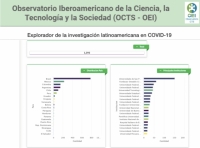
Ibero-American Observatory of Science, Technology and Society (OCTS, its spanish acronym), offered to the public, information about COVID-10 research in Latin America, this was made thanks to the tracing in real time of the work that universities and scientific institutions are doing. Date are obtained from three sources: PubMed, LA Referencia and news from the Regional Office of Science and Technology for Latin America and the Caribbean
Users can access to the statistical information in two ways: graphic summary, and a more detailed explorer where people could see data by country and institution.
The OCTS explained that they will continue monitoring trends and new research fronts to science’s fight to find a cure for COVID-19.
You can access to the explorer here.
COAR survey finds no large barriers for repository platforms in complying with Plan S
Written by Comunicaciones
In 2019, a group of funders known as cOAlition S adopted Plan S, a set of principles and requirements for full and immediate Open Access to peer-reviewed scholarly publications resulting from the research they fund, beginning in 2021. One of the routes for complying with Plan S is for authors to make the final published version (Version of Record, VoR) or the Author’s Accepted Manuscript (AAM) openly available with an open license in a Plan S compliant repository with immediate OA from the date of publication.
In order to support compliance with Plan S, repository software platforms, repository managers and researchers (who use the repositories) will need to be aware of the requirements and, in some cases, adopt new practices and functionalities. In April/May 2020 the COAR, in consultation with cOAlition S, conducted a survey of repository platforms in order to assess their current ability and intention to support Plan S requirements, and to identify any specific challenges related to their implementation.
The survey found that most repository platforms currently support compliance with Plan S mandatory criteria and, in the few cases where they do not, there are plans to adopt this functionality. In addition, many of the highly recommended criteria are also already supported by the platforms. As a next step, COAR and cOAlition S will continue to work together to ensure that repositories are well represented and to develop more detailed guidance that assist them in supporting the major functionalities envisioned in Plan S.